Trevor Abes: Writer

Tag: plays

Review: Blood Offering (alma matters productions)

The ability to identify art that challenges, enlivens, and ultimately enriches the collective imagination is what has set alma matters productions apart since its inception in 2016. This remains the case with the company’s final staged production, Blood Offering, written by Vishesh Abeyratne, a considered meditation on the perils of ideology, youth and grief that never reneges on chances to ramp up the tension, or release it, releasing us into world-weary relief.
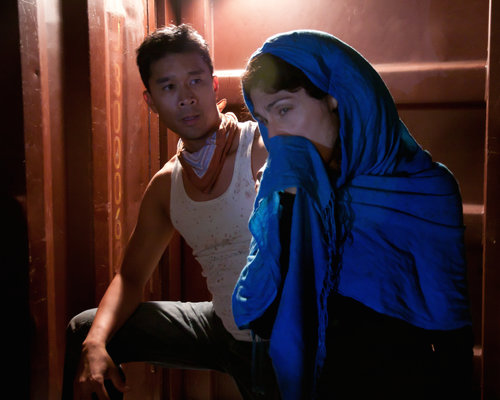
The story centres on the aftermath of a school shooting in the U.S. Midwest, where Farid (played by Faraz Farsijani) and his teacher, Mr. Naqvi (played by Suchiththa Wickremesooriya), bond over their shared loss of friend and student, Kayla Gordon.

The pair offers up undeniable chemistry, as if loved ones with long-established expertise in viewing each other’s shortcomings as calls for tenderness. Farid, twice his size with idealism and radicalism, paired with Mr. Naqvi’s Socratic-method brand of reason, guide us through a reconciliation with loss where trust and respect act as universal safety nets. Their connection, stretched by ideological differences, produces industrial-strength tension any writer should be proud to have played a part in materializing.

Farsijani is adept at reminding us of the potential for danger in the certainty of a youthful conviction. Having not yet internalized the regularity of failure and loss, Farid views his own as unique, beyond true understanding by anyone but himself, and I felt his outrage in my bones. With him, we walk the fine line between sustainable self-soothing and the lonely’s susceptibility to extreme action as if we too were 15 again.

Wickremesooriya, a pleasing foil to Farsijani, serves up Mr. Naqvi’s soft-spoken, in-line demeanor as the key to a stable life in society, but one that also forces him to swallow his tongue in the name of safety, generating a festering sense that he is not embodying his authentic self. 

When Kayla’s parents, played by Sarah Angelle and Oliver Georgiou, enter the fold with a plan to avenge their daughter’s death, the story takes a bigoted and deadly turn with consistent action-movie-level excitement, while remaining firmly rooted in each character’s subjective struggle to coexist with grief.

Angelle is chilling and calculated in her portrayal of a mother who doesn’t know how to find relief from a child’s absence without causing pain to others. The mammoth, unapproachable scale of the socio-economic issues at the root of her daughter’s demise have left her no other recourse, calls to elected representatives having made no difference to the depth of the pit in her stomach. Mrs. Gordon’s resolution stems from surety that can only emerge from someone at wit’s end, where reason and the comfort of memories no longer hold sway.

Georgiou, for his part, gifts us with comedic relief that dips into the medicinal. Mr. Gordon’s mustache and voice, imbued with the calming blandness of Ned Flanders, simmers down every action that threatens to boil over with the astute precision of a risk manager and the common sense of the dad of all dads. While bloodthirsty as his bride, his insipidness as personality takes the edge off and makes digestible the fact that people who choose ignorance and violence are fallible, complex balls of emotion like the rest of us.

Farsijani and Wickremesooriya, as if in a two-hander all on their own, usher Farid and Mr. Naqvi’s bond to new highs of loyalty and gratitude in a finale that satisfies for how grandly and tidily it ties the play’s major themes together; namely, the inseparability of struggle from fulfillment, and the mixed blessing of being willing to sacrifice your freedom for what you believe in.

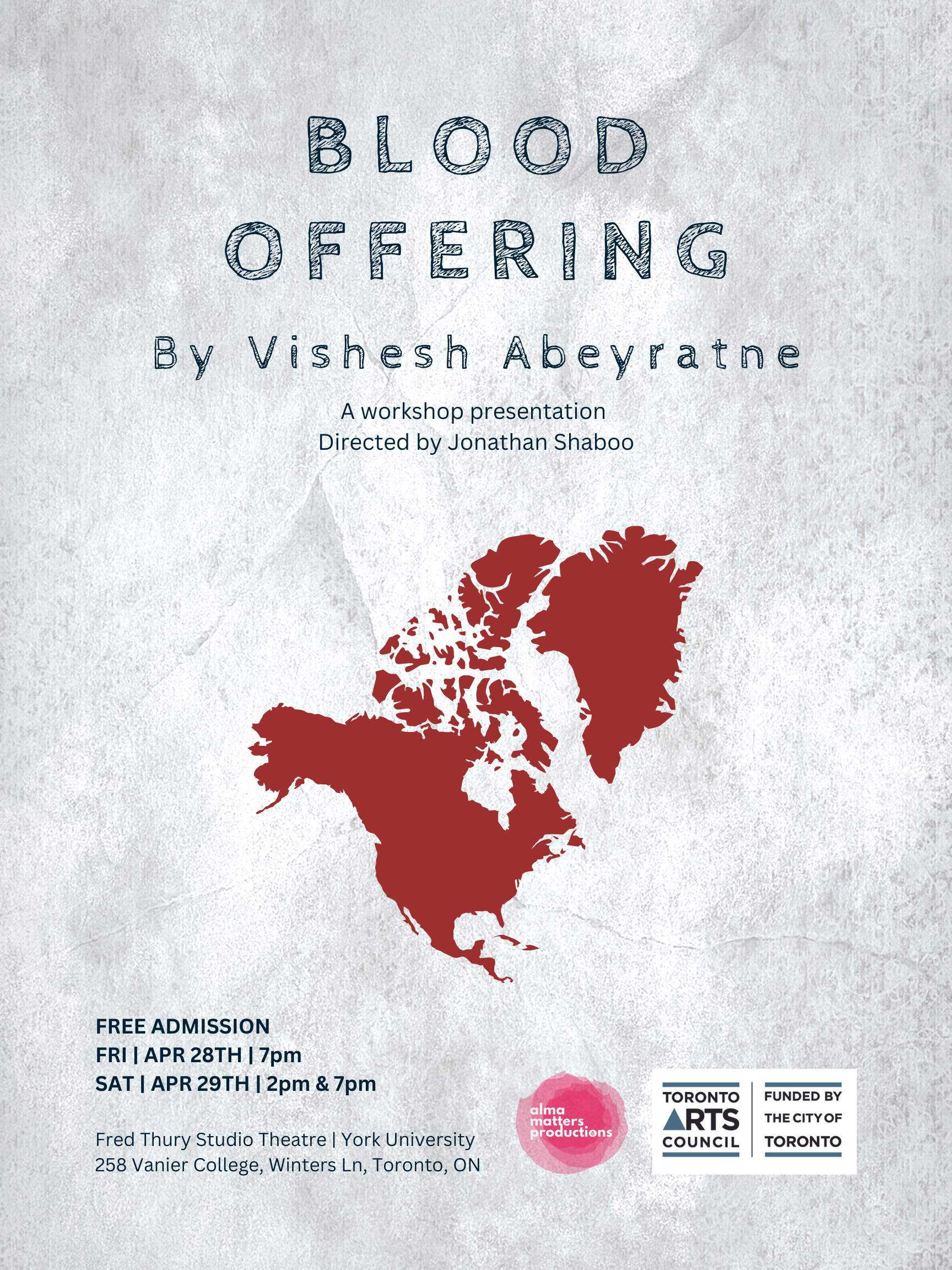
Considering that 1) all this delectable complexity of character and genuine thriller vibes rarely, if at all, asks us to suspend disbelief, thanks in no small part to director Jonathan Shaboo‘s intentional use of limited space, and 2) it originated from a workshop performance, scripts in hand, I’m going to go ahead and say that witnessing Blood Offering’s layers unfolding within the vividness of a fully developed production is an experience you should make room for when the opportunity presents itself. 


Blood Offering was workshopped at York University’s Fred Thury Studio Theatre.

Review: Iphigenia in Splott (Skipping Stones Theatre)

The amount of room you keep free for people you don’t like says a lot about you. How far from your views on politics, sex and gender, religion, life and death can you wander, curious and receptive, before you won’t hear another word, regardless of who might be speaking, and what they may have been through?

Breanna Maloney as Effie.

If said space is expansive, your capacity for empathy is likely just as generous. If it’s a little tight, you may find it easy to dismiss other people’s life choices and life plans, except for a chosen few whose ideologies reflect the world you want to see.

Enter Skipping Stones Theatre, a Toronto collective dedicated to storytelling that aims to create/expand/entice your appetite for neurodiversity and understanding of mental health. Their latest, an adaptation of Iphigenia in Splott by Gary Owen, is a solo show best described as an exercise in social change by catharsis. 

Our lone protagonist, Effie, played by Breanna Maloney, is a poor, heavy-drinking, foul-mouthed and promiscuous woman for whom mainstream British society has little room to spare. She is a reference to U.K. austerity measures from the mid-2010s that spawned the politically fabricated and widely popularized notion that those most affected by the cuts – the poor and the mentally unwell – were to blame for their misfortunes.

Effie’s brashness, initially off putting in a punk middle finger kind of way, very quickly shifts into a shield between her and the outside world as we learn more about her obstacles and motivations. Her best medicine for what the highs of sex and drunkenness fail to numb – limited job prospects, unreliable social services – is a ‘fuck you’ to whoever’s within earshot. Passivity and acquiescence are no balm for a systemic lack of opportunity, one where those who can walk to a decent life have been swayed by those in power to expect her to grow wings and take flight there, and look down on her for not being able to.

Her abundance of self-preserving volume and aggression, set against her borderline-naive eagerness to feel and be understood, gradually saturated my headspace with her humanity, such that I could see the impact of it cleansing a narrow-minded patron of their belief that people like Effie are unworthy of their aspirations. At the very least, Maloney’s work does a lot of the heavy lifting in that direction, true to the company’s mandate. This is the social change the play is crafted to induce, by force of feeling, yes, waves upon waves of it, but also plenty of humor stemming from Effie’s blunt retorts, and a number of poetic conceits that elevate the whole work for me into the kind of theatre that endures because it not only represents the underrepresented, but does it with a sense of craft. One of these conceits, the superhero-ish ramifications of certain people being in Effie’s debt, is worth more in enchantment than the price of admission.

The play’s aforementioned exercise develops more organically than I’m making it sound. I slowly let go of self-awareness at the mercy of Effie’s tireless, expletive-laced tirades as space-time might be constricted by a favorite song. She says and does as she likes, while having mastered, by the precarities of her situation, the essential survival skill of not caring what most people think of her. She pursues what she wants, fearlessly and shamelessly, and when she is afraid or ashamed, she is able to stride through the flames of it accepting her flaws with open arms. All of this equals a mesmerizing character, and outside of the theatre, a human being with incredible potential. This is why Effie’s succession of tragedies, many of which she is basically fated to endure, stun as effectively as they do, and are liable to slide the ground from beneath your feet to make you revisit who’s deserving of your good graces.

Lighting Designer, Chin Palipane and Movement Consultant, Alice Cavanagh are adept at maximizing the intimacy of the moment, while also offering a sense of structure with their choices to this otherwise starkly presented play. The starkness, of course, is intentional, with Director Sean O’Brien astutely aware that Effie will more than capably fill up the almost bare stage on her own.  Combined with Maloney’s gift for bringing not only Effie but her whole community to life with but one body to work with, Iphigenia in Splott manages to break through its U.K. confines with a deeply felt portrayal of social inequality and the colossal strength required to climb out of it.

The show runs until July 17th as part of Toronto Fringe. Ticket info here.

Review: Save Room for Superior Donuts

Here’s my review of Coal Mine Theatre’s Superior Donuts! On til Feb 26. Read it here on The Theatre Reader

designed-by-kostis-petridis

Poster by Kostis Petridis.

The Container is Interactive Theatre at its Activist Best

It’s that good. Here’s why.

The Container photo by Lauren Posloski

Photo by Lauren Posloski.

Markowiak’s Lemon Tells The Young Adult Blues

My review of Andrew Markowiak’s LEMON, produced by Filament Incubator. Read it in Sewer Lid Magazine.

Lemon

Theatre of the Oppressed: Jordan Tannahill’s Botticelli in the Fire and Sunday in Sodom

My review of Jordan Tannahill’s double bill in The Theatre Reader

Botticelli in the Fire “[tames] political and religious fundamentalism into conquerable myths.”

Sunday in Sodom “is an act of reclamation that lives up to the proportions of the book it comes from.”

Read it here.

Botticelli in the Fire photo by Cylla von Tiedemann

Photo by Cylla von Tiedemann.


Communicating Without Ego: Then They Fight Theatre’s Our Idiot Friend Is Now Dead

101010 poster

Photo by Cesar Ghisilieri Photography.

My review of this year’s 10/10/10 Project — Then They Fight Theatre’s Our Idiot Friend Is Now Dead — is up today in Sewer Lid Magazine.

Read it here.