LiterArti 2016 #PoetryInThePark
I’ll be reading new poems at LiterArti at Wychwood Park on September 24th!
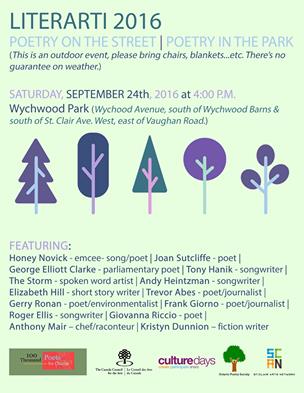

I’ll be reading new poems at LiterArti at Wychwood Park on September 24th!
Happy to share that I’ll be facilitating a performance workshop this June in a month-long series alongside Jay MillAr, Liz Worth, Tabatha Stuhlmueller and the Toronto Arts Council. It’s $40 all-included. Grab a spot here.

Part of my feature at Milton District High School for Mrs. Gleason’s 12th grade writer’s craft class poetry slam.
That cafeteria backdrop though.
Filmed by Michael Abes.
A new poem, “Family Dinner,” performed at The Supermarket in Toronto. It’s also forthcoming in print in Rummaging for Words.
Outrageous is a new reading series in Toronto that’s turning heads and making friends by breaking all the rules. Read my article about it in Torontoist.
If you’re in the city, come by for Outrageous X on September 29 at 8 p.m.

From Outrageous VIII: Alex Hood on bass and Callum MacKenzie on sax as the Rainbow Jackson Free Jazz Experience. Photo by Maite Jacobson.
 1. Research how to locate and outline the chin of a toy terrier. Find a toy terrier, outline its chin, then count the hairs on said chin to determine the number of lines your poem will have.
2. Purchase a hatchet and 7 copies of your most loathed newspaper. Stack the newspapers and roll them together, fastening the resulting cake roll with elastic bands. Plate and freeze. In the morning, slice off a dessert-sized portion for melting next to your bowl of cereal and cup of black coffee. If, after breakfast, you cannot deduce at least one thing you hate about the newspaper from the soggy mush, its contents will determine your poem’s subject matter. Otherwise, dump it in the trash and try the next slice tomorrow.
3. Suppose you spot the word “politics” upside down drooping over the plate onto the table and the name “Tibetan Mastiff” crossed with the word “court” in the middle of the plate where ink should be pooling. You decide to take as your theme the history of court cases in which both defendant and prosecution are of the Tibetan Mastiff breed.
4. Research famous Tibetan Mastiff trials and choose one. Suppose you choose Price v. Shanti 1983, where one Shanti Warren was accused of stealing one Price Kennedy’s gold-encrusted leg of lamb and taking it abroad from Toronto to Botswana, where security discovered counterfeit AAA-grade kibble inside of it and duly detained her.
5. For rhythm, think of the last song you had to turn off to stop yourself from getting sick of it. Play it on repeat and improvise about the case; be how you wish you were most of the time; do this until your ears are worn to the metal. Then, continue in and relish the silence. Record using tape or laptop microphone.
6. From the resulting material, select sentences you enjoy as they stand on their own.
7. Try to put them together.
There’s a new rapper on the scene, and he’s got an English degree.
On June 19, 2012, Miles Duke released Zone Out, his first EP, available for free download on Media Fire here . And ‘personal’ is the word from the first lyrics spat. From his eating habits, to his taste in women, to his sometimes manic delivery in search of a solid meaning for life itself, Duke’s heart beats out his chest in every song with freshness and vulnerability. Yet, what’s most personal about Zone Out is the raw clearness of Duke’s thought-process. Here’s an analogy: “Pop Champagne” provides virtually no insight into Jim Jones the person; the song wasn’t made to get to know him, but to feel a little hood while admiring how well he’s done for himself. Conversely, Duke’s approach to song-writing takes having nothing to prove as its starting point.
You’re not supposed to know that Ghostface Killah’s real name is Dennis Coles for a reason. It contrasts with Wu-Tang’s image. So, in the absence of an image, Duke takes to making his own one tune at a time.
His lyrics are surrealist, stream of consciousness poetry that reward in proportion to the attention you put in. It becomes clear after a few minutes that, as listeners, we are meant to follow Duke’s thought process much like we are the protagonists of David Foster Wallace stories: we are asked to be entertained by the act of communing. The opening track, “Inspiration,” begins with atmospheric synths with vocal harmonies on top; Duke promises a “positive space ” with “dollops of taste,” thus setting the album up as an aesthetic affair, a Nabokovian series of explorations of how rhythm and poetry can affect the senses.
“Now” is an energetic, head-banging piece that contains an important meta moment for the album as a whole: the line, “my cadence is far from basic,” coupled with Duke’s proclamation of his “mission with diction,” forms a mission statement that is for diction as well. Specifically, for a change in mainstream hip-hop’s underestimation of the power of words to affect people’s behavior. Zone Out is composed of fragmented, semantically saturated confessions that demand listener participation rather than passive consumption; it is largely brand-name-free.
If a sliver of meaning is unlocked, or if a petal of beauty successfully crosses Duke’s cerebral bone barrier into yours, his purpose of reaching you with his soul rather than with guns and girls is validated.
Beginning from the two-minute mark, the tittle track contains the most memorable bars of the album. As soon as Pynchon’s Gravity’s Rainbow is name-dropped, the rapper is clearly sparked by it, unleashing deconstructed stanzas with complete confidence in himself (as well as the rare mid-bar pause). The absence of choruses, a hallmark of underground hip-hop, affords Duke this explosive freedom and, when coupled with the pop-crossover beats that take up most of the album, reveals his mainstream influences under the veil of a challenge: to determine whether there would ever be a context in which what we’re hearing is a hit song. If not, why?
Check out the Zone Out album cover.

 Trevor Abes: Writer

