Ephemera
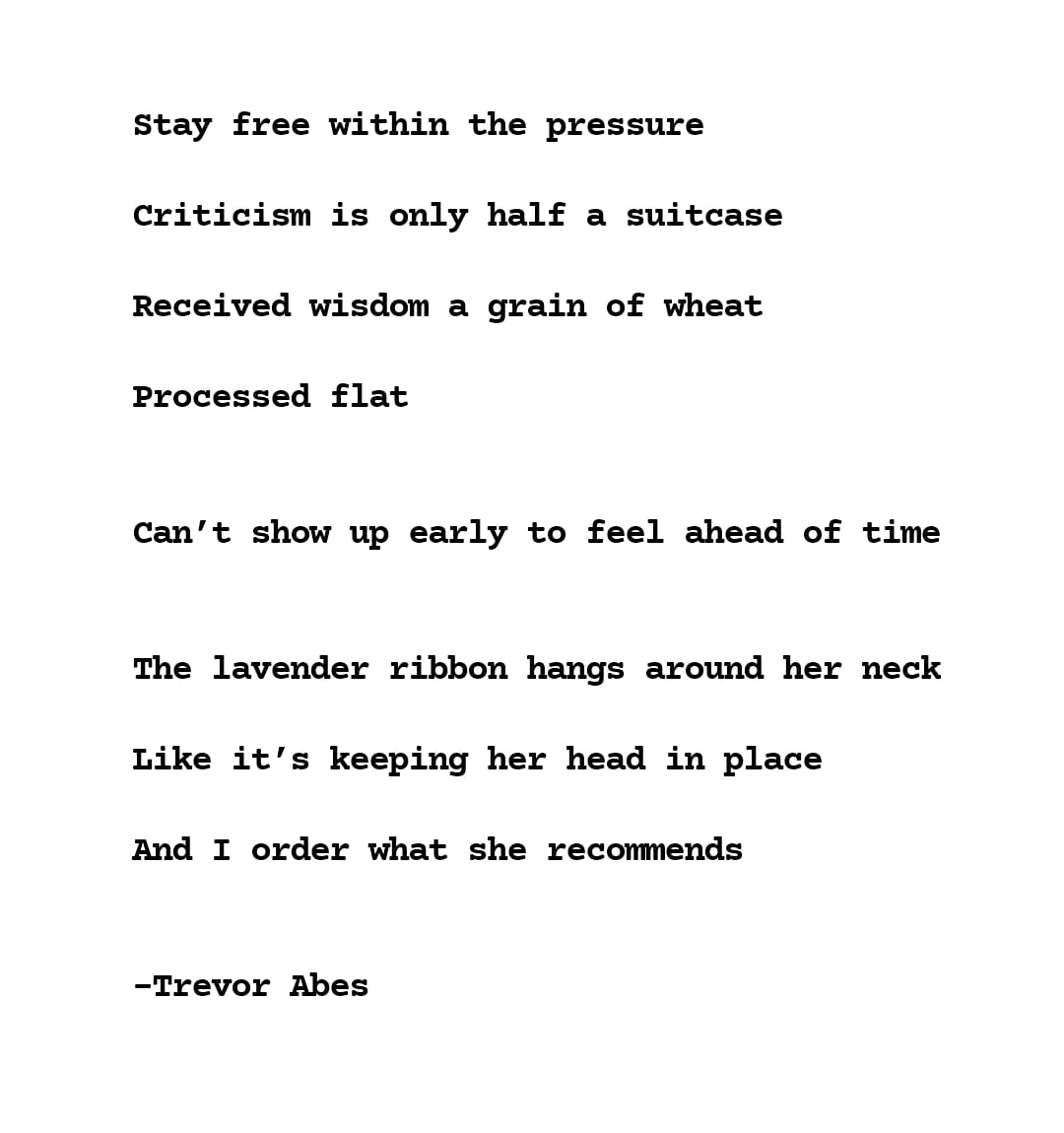

I was on the radio talking about and reading from my poetry collection, The Breakup Suite.
Howl’s host, Valentino Assenza, and I also cover some basics about investing and personal finance.
My interview starts around 43:00!
Howl episode April 20, 2021. (the episode will be available to listen/download until April 28)
Here’s me on Howl for the first time back in 2015.

Honoured that my friend Jeff took the time to write so insightfully about my book of poems. Nothing but appreciated, good sir.
The series of poems contained in Abes’ beautiful collection is almost too raw emotionally to be judged fairly in aesthetic terms, yet the language is undeniable. The Breakup Suite is about exactly what it sounds like.
You seldom ever see someone else at their lowest emotional moment, fresh after a breakup of a 5-year relationship, and if somehow you do, you don’t expect it to be written about at all, let alone like this. You expect the person to be a fucking mess, yet the outpouring of a heart here is graceful, measured, balanced, contained.
The poems are as much a triumph of spirit and resolve as of language. The love of writing is as palpable as Abes’ love for “E.”
I felt like, for Abes to move on in life, the sentence and the sentiment had to be pitch perfect. Working out his own feelings and expressing them just…
View original post 505 more words
Learning about stocks and bonds and investing in them aren’t necessarily conducive to each other because one of those options doesn’t require you to put up any money. Safe to say that, as young people, we’re not necessarily swimming in it as a whole. I get it.
There’s a lot to learn, and getting to the point where you’re comfortable buying shares of investment funds on your own is a tall order once you’re tasked with delivering on it, even if you know a globally diversified stock portfolio has made about 7% per year over the last two decades.

It’s always difficult when you start from knowing nothing next to nothing about a subject, but I think there are common hurdles to getting invested that, once removed, should make the process of opening an RRSP/TFSA, choosing funds, buying them regularly, and selling them to fund your financial goals seem less daunting than it should.
Here’s what may be holding you back.
Investing is scary. To spell this out in a more specific way, the fact that stock prices go up and down every day, often with no discernible reason, makes the stock market seem like a less than ideal place to store money.
Here’s the antidote.
The global stock market fluctuates in the short term but goes up over long periods of time. The Canadian stock market alone has returned about 9% a year over the last 60 years and the U.S. market has returned close to 10% per year over its history. You can buy funds that own the global stock market, or a collection of stocks that replicates it, and pay a very cheap yearly fee as you add to it over the long term. The same goes for the global bond market.
The stock market feels like gambling. This is a thing people say. Mostly because there are plenty of people who use financial instruments as a way to make bets as opposed to invest. The nice thing here is you can choose to be an investor and ignore those rolling the dice with their dollars.
It’s gambling to buy shares of Shopify because you think it will beat estimated earnings for the upcoming quarter causing the stock to pop. But there’s no 20-year period in history in which owning a diversified stock portfolio has lost money. Stocks, as a whole, have a positive expected return. This a casino cannot say. Shopify could miss estimates, fall by 10%, and leave you wondering whether you should hold or sell.
Investing feels like it won’t make a difference to your quality of life. This one is 100% true in the present moment and for the foreseeable future. Why? Because it takes decades for investing to work, for the money you make to stack on top of itself and grow in spite of the normal daily fluctuations and pandemics and major shipping lane clogs we all have to deal with.
You’re not investing for who you are now, not completely anyway. It’s mostly for who you will be 20-30 years from now. Sure, there are financials goals you have now, things you want to make of your life that you need to save for. Your dreams are an essential reason to invest.
You also need to remember, though, how easy it is to forget how different you are from 16-year-old you. And I don’t mean this superficially. Your view of the world, of what has value and serves your purpose, has changed so much since then to the point of being unrecognizable.
I wanted to be in the NBA when I was sixteen. I report on Canadian business news now. The road between the two isn’t logical except to me and what lights me up inside and out, just like your journey.
What will the vibe be 10 years from now? Who knows. All I know is that I will probably want as much breathing room as possible whenever I decide I need a change, which will surely happen, change being the only constant on this rotating rock of ours. Investing regularly is how I guarantee that peace of mind.
Putting money away takes away from living in the present moment. Yes, this is technically true. Money invested is gratification delayed to get more out of that dollar at a later time. But there’s no black or white here. It’s a balancing act between enjoying yourself now and building toward getting yourself to a place where you don’t have to worry about money.
I like concerts and plays, weekend getaways, and patio brunches just as much as the next person. I’ve enjoyed my fair share of $20 plates of eggs and potatoes in good company and have no qualms about it at all. That hasn’t stopped me from saving half my income over the past three years to minimize the financial ups and downs that come with writing for a living.
If you need to maximize your dollars, as most people do, to give yourself the greatest chance at living with your version of dignity until you’re old and crusty, investing is your only option besides finding a job that pays you enough to not have to.
If you’re interested in getting started and learn best by reading, I have a short instructional e-book (scroll down to the last book on the page) for beginner investors.
There are also 30 past articles in this series you can peruse.
I’m also offering one-on-one investing chats to cover basic knowledge and equip you to invest on your own.
As always, feel free to drop any investing questions in the comments.
Disclaimer: This article is meant for general education purposes only. It does not constitute financial advice as I am unaware of your personal situation. Consult with a professional who abides by a fiduciary standard before making any investment decisions.

—Liked what you read? Grab a book.
When the broken glass of life
Scrapes dead weight from parts of you
You still treasure, gathering the slivers
Is a short path to hypersensitivity
As opposed to applauding the poetry
Of how long you’ve had your head down
Letting the unfairness nestle
Into the corners of your smile
And bloom into the tender sweetness of a heart
Whose open arms proved insufficient
The music in your hips newly sprung by bae’s absence
Her face in every woman’s face regardless of age
Stop trying to stop seeing her everywhere
Stop beating yourself up for finding yourself asking
What do you mean what do I mean by love?
Years into thinking the answer was set in stone
Just steep in it and get familiar with how you are
Too much food to finish for basically everyone
Until someone comes along happy to wrap you up
And save you for delectable exploratory unravelling
Which, for the record, is the opposite of cutting back
To compromise on the tenant between your eyes
—Liked what you read? Grab a book.
There are people out there in the world who are trained to manage other people’s money. They’re called financial advisors and a well-chosen one can serve a meaningful purpose in your life if you actually need the help.

Let’s begin by explaining how a relationship with a financial advisor generally works. It’s pretty simple: you hire one to handle your investments and help you build a financial plan and you pay them a fixed percentage of those investments— usually around 1%—every year for their services. Certain financial advisors will opt for a flat fee instead because they consider it fairer to be paid the same no matter the client they’re working with. Notice how that’s not the case with a 1% yearly fee, because the more you invest, the more that 1% will represent.
We’ve already learned about reasonable return expectations when investing in a diversified portfolio of stocks and bonds, so what could possibly make it worth it to give up as much as 1% of that return every year to have a trusty advisor by your side?
You don’t have the time. It’s totally understandable if your life and work don’t leave you with the time you need to learn how to invest, much less manage those investments in a confident way on a regular basis. When family and career are your priorities, you’ll be able to give your all to them by interviewing a handful of advisors to find the right one for you.
You don’t have the mind. In this scenario, you could have all the time in the world but zero interest in acquiring investment knowledge. For some, the subject is such a bore to the point of being upsetting and I get it. Everything is not for everyone, and it’s senseless to be ashamed of that. That’s why experts exist in any field who can help you for a reasonable fee. And in many cases, like tax planning, and wills and estates, you’re going to require a level of expertise that probably isn’t feasible to pick up by reading up on it over the weekends. In many cases, you want the confidence of a professional having done the thing right.
You can afford the convenience. The beauty of money is that it can buy your freedom. Just like you may be perfectly able to clean your house once a week, but choose to pay someone to do it to free up a few hours for family time on the weekends, the same can be said for the work involved with managing your financial affairs. If you’d rather be doing something else, and can pay an advisor to take care of your money, going ahead and doing that will add value to your existence.
Now, what qualities does a stellar financial advisor exhibit?
If you put the points we’ve discussed into practice, you’ll find exceptional financial professionals to have in your corner and grow your money responsibly over time. On the flip side, if you’re more than willing to learn how to invest for yourself, there are plenty of books and videos out there to get you started. Consider my new book, Nine Steps to Successful Investing: A Guide for Young Canadians, to begin your investing journey and improve your financial health in no more than an afternoon.
I’m also available to teach you 1-on-1 over Zoom if you prefer.
Feel free to drop any questions in the comments!
Disclaimer: This article is meant for general education purposes only. It does not constitute financial advice as I am unaware of your personal situation. Consult with a professional who abides by a fiduciary standard before making any investment decisions.




 Trevor Abes: Writer